

What “transaction time” actually means—and why most estimates are misleading
One of the most common misconceptions in real estate is how long a transaction actually takes.
You’ll often hear:
“2 to 3 months to close.”
That number is not wrong. But it’s incomplete and often irrelevant for cross-border investors.
To understand real timelines, we need to define what is actually being measured.
What “transaction time” really measures
The most widely cited dataset in Europe comes from the Drooms Real Estate Trends Report, which tracks real transactions across institutional and private markets.
According to the latest data:
The average transaction time in Europe is 363 days
But this does not mean:
- From when a property is listed
- From when a buyer starts searching
Instead, it specifically measures:
The period from the launch of a structured sale process (typically when due diligence and bidding begin) to final closing (legal transfer of ownership).
In practical terms, the clock starts when:
- A serious buyer is identified
- A data room is opened
- Due diligence begins
And ends when:
- Contracts are executed
- Funds are transferred
- Ownership is legally registered
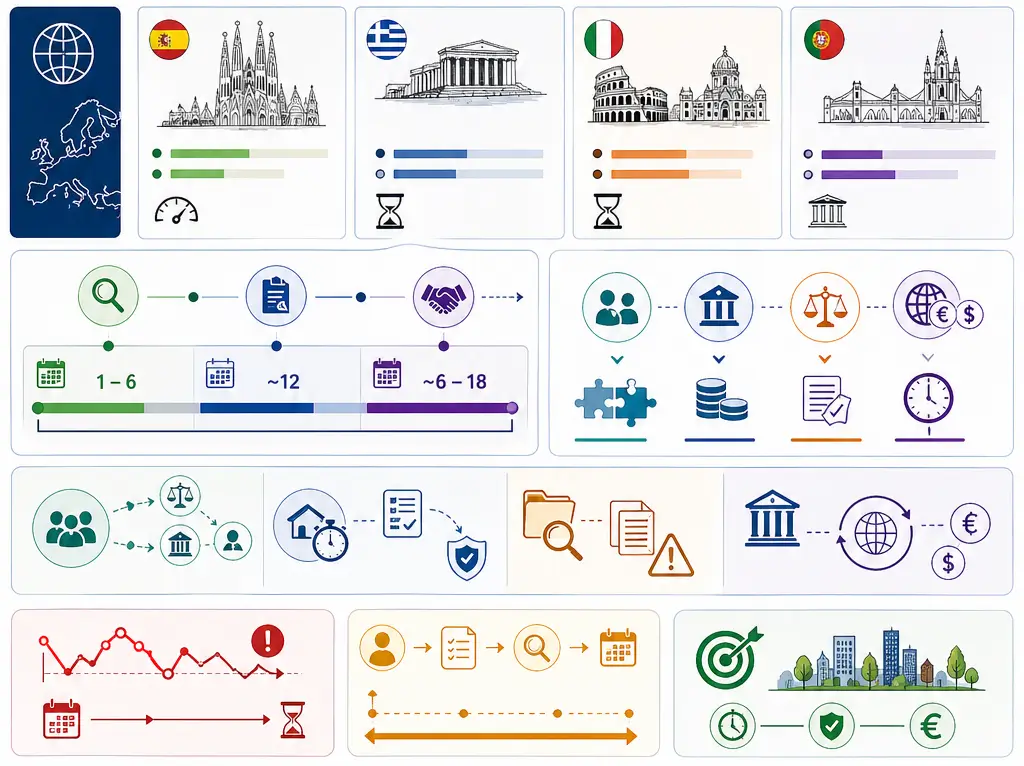
The three timelines every investor confuses
To understand real-world duration, you need to separate three distinct phases:
1. Search & Market Phase (Not included in “363 days”)
This includes:
- Property listing
- Buyer discovery
- Negotiation before formal process
Typical duration: 1 to 6 months depending on market liquidity
This phase is:
- Highly variable
- Often invisible in official statistics
2. Transaction Phase (This is the 363 days)
This is where most complexity sits.
It includes:
- Due diligence (legal, technical, financial)
- Negotiation of final terms
- Financing arrangements
- Regulatory and compliance checks
Average duration: 363 days across Europe
Key point: This is after both parties are already committed to the deal.
3. Closing & Settlement Phase (Included in the 363 days)
The final stage includes:
- Contract execution
- Payment coordination
- Ownership transfer
- Registration
This is where:
- Timing becomes critical
- Delays often compound
- Transactions can still fail
Country-level reality (within this framework)
Spain
- 244 days average transaction duration
- Residential deals often quoted at 3–6 months
Faster than the EU average, but still subject to delays in financing and legal checks.
Greece
- 6 months to complete a transaction phase
Additional delays from administrative processes and title verification complexity.
Italy
- 3–6 months baseline closing timeline
Frequently extended by bureaucracy and mortgage approvals.
Portugal
- 3–6 months standard transaction timeline
- +1 month when financing is involved
Performance depends heavily on banking efficiency.
The real end-to-end timeline
| Phase | Duration |
|---|---|
| Search & discovery | 1–6 months |
| Transaction (measured) | 12 months |
| Total lifecycle | 6–18 months |
Why transactions remain slow, even after agreement
The key insight from the data is:
Even after a deal is “real,” execution remains inefficient.
1. Fragmented coordination
- Lawyers
- Notaries
- Banks
- Brokers
No unified timeline or system of record.
2. Financing friction
- Mortgage approvals add 30 days on average
- Cross-border buyers face additional compliance layers
3. Legal complexity
- Title checks
- Tax liabilities
- Documentation gaps
4. Payment infrastructure mismatch
- Bank cut-off times
- FX delays
- Lack of synchronized settlement
This is where transactions break at the last mile.
What most analyses miss
Most market commentary treats transaction time as predictable.
In reality, it is:
- Non-linear
- Stop-start
- Dependent on coordination between parties
This leads to delays, renegotiations, and late-stage failures.
Strategic takeaway
The problem in European real estate is not deal discovery, it is deal execution.
Even after:
- A buyer is found
- Terms are agreed
- Due diligence begins
It can still take up to 12 months to close.
Final thought
Europe has optimized:
- Property search
- Listings
- Legal frameworks
But it has not optimized the transaction layer.
Until that changes:
- Time-to-close will remain long
- Deal certainty will remain fragile
- Capital will remain inefficient