

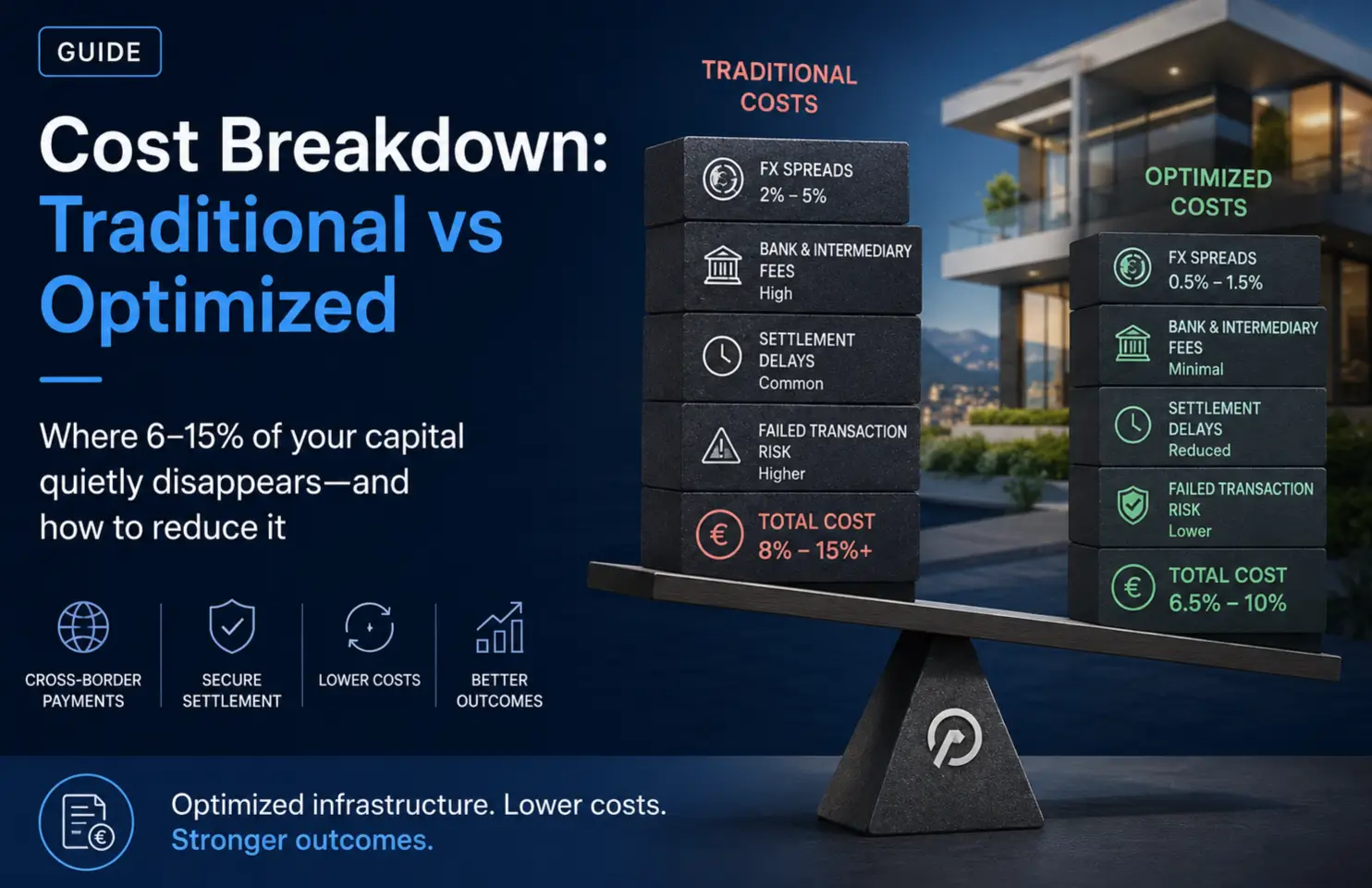
Where 6–15% of your capital quietly disappears, and how to reduce it
Most investors focus on property price.
Smart investors focus on transaction cost.
Because in Europe, the difference between a poorly structured deal and an optimized one is not marginal.
It is often between 5% and 10% of the total transaction value.
On a €500.000 property, that means €25.000–€50.000 in additional costs.
The Baseline: What a “Normal” Transaction Actually Costs
Across Europe, real estate transaction costs typically range between 6% and 11% of the property value.
In some markets and structures, total costs can approach or even exceed 15% when taxes, commissions, financing, and international payment inefficiencies are combined.
Typical Traditional Cost Structure
| Cost Component | Typical Range |
|---|---|
| Property transfer tax | 3% – 6% |
| Notary & registration | 1% – 2% |
| Legal & due diligence | 1% – 3% |
| Agent commissions | 2% – 6% |
| Total baseline cost | 6% – 11%+ |
But these are only the visible costs.
The Hidden Layer: Cross-Border Payment Costs
Once money moves internationally, a second layer of costs appears.
This layer is often underestimated because many costs are hidden inside exchange rates, intermediary banking networks, and timing inefficiencies.
Foreign Exchange & Payment Costs
| Payment Component | Typical Cost |
|---|---|
| Traditional bank FX markup | 3% – 5% |
| Fintech FX spread | 0.5% – 1.5% |
| International wire fees | €15 – €50 |
| Intermediary bank fees | €10 – €30 per transfer hop |
| Stablecoin on/off ramp costs | 0.5% – 2% |
In large transactions, FX costs alone can exceed legal fees.
Real Example: €500.000 Cross-Border Property Purchase
Traditional Transaction Structure
| Cost Category | Estimated Amount |
|---|---|
| Property transaction costs (8%) | €40.000 |
| FX spread (3%) | €15.000 |
| Bank & intermediary fees | €500 – €1.500 |
| Total transaction cost | ~€55.000+ |
That represents more than 11% of the property value lost to transaction friction.
Where the Money Actually Goes
The important insight is that most costs are not fixed.
They are structural inefficiencies.
1. Taxes
Taxes are usually jurisdiction-dependent and difficult to optimize.
These costs are largely fixed.
2. Professional Fees
Legal fees, notary costs, and commissions can sometimes be negotiated, but only within a limited range.
3. Payment Infrastructure
This is where the largest inefficiencies usually exist.
Examples include:
- Excessive FX spreads
- Multiple correspondent banking layers
- Repeated currency conversions
- Delayed settlements
- Uncoordinated payment execution
Unlike taxes, these costs can often be significantly reduced.
The Optimized Transaction Model
An optimized transaction structure focuses on improving three critical areas:
1. Better FX Execution
Reducing FX costs from 3–5% to approximately 0.5–1.5% can generate substantial savings.
On a €500.000 transaction, this alone may reduce costs by €10.000/€20.000.
2. Reduced Intermediation
Using fewer intermediary banking layers creates:
- Lower transfer costs
- Faster settlement
- Improved transparency
- Reduced operational risk
3. Coordinated Settlement
Aligning:
- Legal execution
- Buyer funds
- Seller confirmation
- Final transfer timing
reduces failed transactions and unnecessary delays.
Traditional vs Optimized Cost Structure
| Cost Category | Traditional Structure | Optimized Structure |
|---|---|---|
| Property costs | 6% – 11% | 6% – 9% |
| FX costs | 2% – 5% | 0.5% – 1.5% |
| Bank/intermediary fees | High | Minimal |
| Settlement delays | Common | Reduced |
| Failed transaction risk | Higher | Lower |
| Total estimated cost | 8% – 15%+ | 6.5% – 10% |
The difference can represent tens of thousands of euros on a single transaction.
The Largest Hidden Cost: Failed Transactions
One of the most underestimated risks in cross-border real estate is failed or delayed execution.
When deals fail late in the process, costs multiply quickly:
- Repeated legal work
- Repeated FX conversions
- Extended capital lock-up
- Lost opportunities
- Additional compliance checks
The cost of uncertainty often becomes larger than the cost of fees themselves.
Why Transaction Infrastructure Matters
Most of the real estate industry has optimized:
- Listings
- Marketing
- Property discovery
- Brokerage
But the transaction layer itself remains fragmented.
Money still moves through disconnected systems with different timelines, banking rules, and operational constraints.
This fragmentation creates unnecessary friction between legal completion and financial settlement.
What Investors Should Focus On
Investors are likely overpaying if:
- Traditional banks are used for large FX transfers
- Payments are executed in multiple disconnected steps
- Legal and financial flows are not synchronized
- Settlement timing is uncertain
Optimized transactions focus on:
- Efficient FX execution
- Predictable settlement timing
- Reduced intermediaries
- Coordinated transaction infrastructure
The Future of Real Estate Transactions
The next evolution of international real estate will not be driven by better listings or more marketplaces.
It will be driven by better transaction infrastructure.
Infrastructure where:
- Settlement is coordinated
- Funds move when conditions are met
- Costs become predictable
- Execution becomes deterministic