

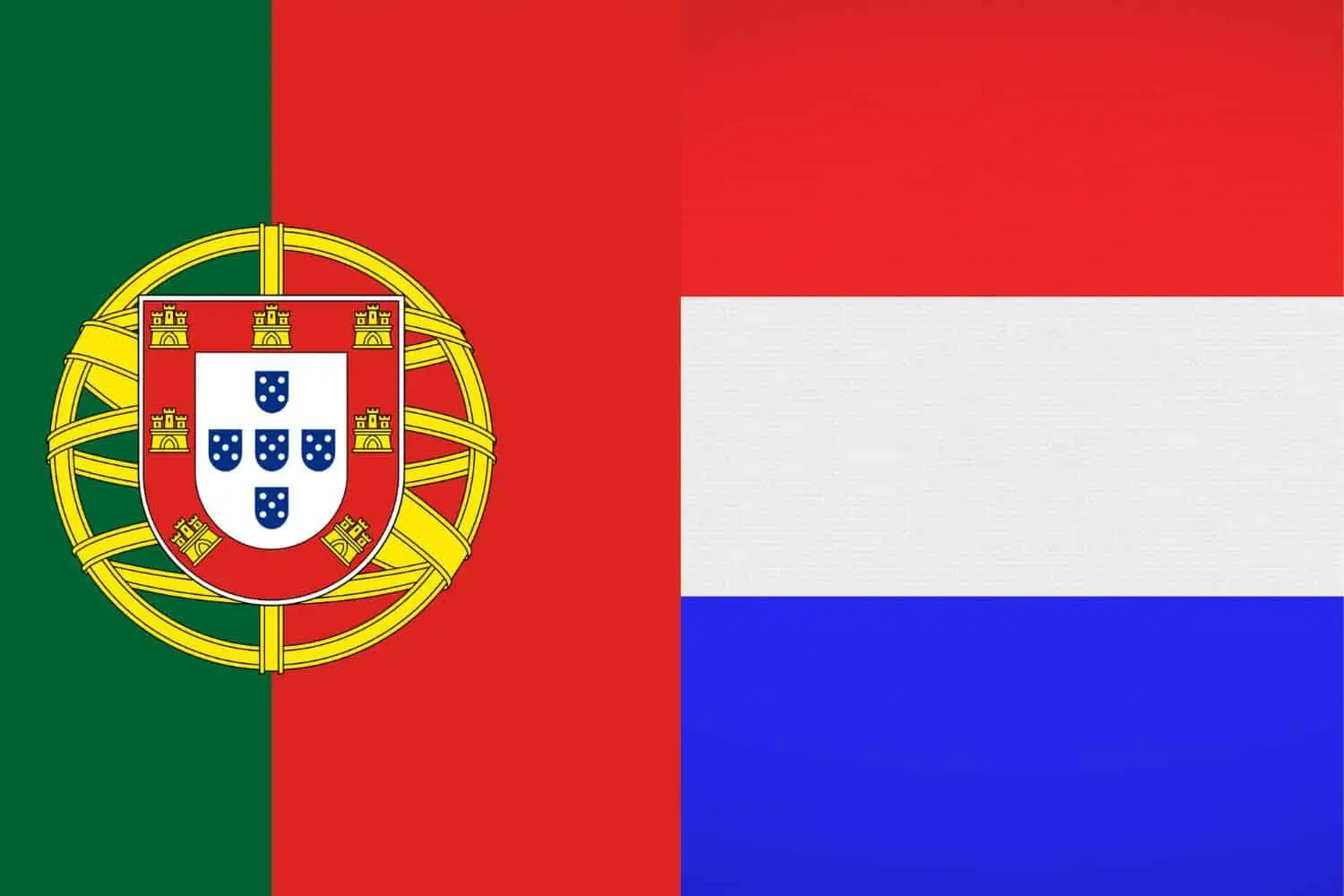
Portugal remains consistently popular with the Dutch. Whether it's a holiday home in the Algarve, a new life as a digital nomad in Lisbon, or retirement in the Alentejo—the appeal of sun, sea, and a lower cost of living is strong. But the rules and prices are changing quickly. This 2026 guide shows what you need to know as a Dutch national.
Cost of Living: What Does Portugal Cost in 2026?
Good news: Portugal is still significantly cheaper than the Netherlands. Current data from March 2026 shows that the overall cost of living in Portugal is a striking 72% lower than in the Netherlands. That's a difference you'll feel in your wallet every month.
| Expense | Netherlands | Portugal | Your Savings |
|---|---|---|---|
| Monthly rent (85m², normal area) | €2,161 | €1,163 | €998/month |
| Monthly public transport pass | €135 | €36 | €99/month |
| Basic dinner out for two | €71 | €35 | €36/meal |
| Beer at a neighbourhood pub | €7 | €2.58 | €4.42/beer |
| Monthly gym membership | €59 | €39 | €20/month |
| Bottle of mid-range wine | €6 | €4.99 | €1.01/bottle |
The cost differences go beyond daily expenses. Childcare shows one of the most dramatic gaps: private preschool in the Netherlands averages €1,976 per month, while in Portugal it's just €454—a 77% reduction that makes Portugal exceptionally attractive for families.
However, there's a catch. While Portugal is cheaper than the Netherlands, it's becoming less cheap. The country is experiencing the highest rental inflation in Europe, with KPMG forecasting an 8.7% increase in rental activity in 2026—the highest in the European Union.
Tax: What Will You Pay as a Dutch Resident in Portugal?
As an EU citizen, you don't need a visa to move to Portugal. You simply register your residence. But the tax implications are crucial.
The NHR 2.0 Regime
Portugal's famous Non-Habitual Resident (NHR) regime was reformed in recent years, but a successor programme—NHR 2.0—still offers significant benefits for certain professions:
- 10-year tax regime for qualifying activities (scientific research, technology, certain high-value sectors)
- Flat 20% IRS rate on Portuguese-sourced employment income for qualifying professions
- No taxation on most foreign-sourced income (pensions, dividends, rental income from abroad) for ten years
- Standard IRS rates (13–48% progressive) for non-qualifying income
What If You Don't Qualify for NHR 2.0?
If you don't fall under the NHR regime, you'll pay Portugal's standard progressive income tax rates:
| Annual Income (€) | Tax Rate |
|---|---|
| Up to €7,703 | 13% |
| €7,703 – €11,623 | 16.5% |
| €11,623 – €16,472 | 22% |
| €16,472 – €21,321 | 25% |
| €21,321 – €27,146 | 28% |
| €27,146 – €39,791 | 35% |
| €39,791 – €51,997 | 37% |
| €51,997 – €81,199 | 43% |
| Over €81,199 | 48% |
Important: No Wealth Tax
One of Portugal's biggest advantages is the absence of a wealth tax. If you have significant savings, investments, or a valuable property portfolio, this is a major difference compared to the Netherlands (where box 3 wealth tax applies) and Spain (which has a wealth tax).
Double Taxation Treaty
The Netherlands and Portugal have a double taxation treaty. This means you generally won't pay tax twice on the same income, but you'll need to work with a tax advisor to optimise your situation—especially in the transition year when you're still financially tied to both countries.
Digital Nomads: Working Remotely from Portugal
Portugal has become one of Europe's top destinations for remote workers. While EU citizens don't need a visa, there are still practical considerations:
Do You Need to Register?
If you stay longer than three months, you must register your residence with the local town hall (câmara municipal). This is a straightforward process for EU citizens:
- Valid passport or identity card
- Proof of income or employment
- Proof of accommodation
- Portuguese tax number (NIF), which you can obtain before arrival
Social Security and Health Insurance
- Employed by a Dutch company: If your employer agrees to you working from Portugal, you may remain covered by Dutch social security under EU coordination rules for up to two years (form A1). After that, you'll need to register with Portuguese social security.
- Self-employed: You'll need to register as a freelancer (trabalhador independente) and pay Portuguese social security contributions (about 21.4% of your taxable income, with a reduced rate in the first year).
Health Insurance
As an EU citizen, you can use your European Health Insurance Card (EHIC) for temporary stays. Once you become a resident, you're entitled to access Portugal's public health system (Serviço Nacional de Saúde), though many expats opt for private health insurance for faster access and English-speaking care.
Digital Infrastructure
Portugal has excellent digital infrastructure. Fibre internet is widely available, even in rural areas. Coworking spaces are abundant in cities like Lisbon, Porto, and Faro, and are increasingly common in smaller towns like Lagos, Ericeira, and Nazaré.
Renting: What to Expect in 2026
The rental market in Portugal is tight. Demand has surged, and supply hasn't kept up.
Current Rental Prices
| City | One-bedroom (city centre) | Three-bedroom (outside centre) |
|---|---|---|
| Lisbon | €1,550 – €1,900 | €2,200 – €2,800 |
| Porto | €1,100 – €1,400 | €1,600 – €2,000 |
| Algarve (Faro/Lagos) | €850 – €1,200 | €1,400 – €1,900 |
| Silver Coast (Caldas da Rainha) | €650 – €850 | €1,000 – €1,300 |
| Alentejo (Evora) | €600 – €800 | €900 – €1,200 |
Rental Trends for 2026
KPMG forecasts an 8.7% increase in rental activity in 2026—the highest in Europe. This doesn't necessarily mean your rent will increase by that percentage, but it does mean:
- Competition for good properties is fierce
- Landlords often require long-term contracts (minimum 1 year, often 3 years)
- Deposits are typically 1–2 months' rent
Practical Tips for Renters
- Obtain a NIF first: You'll need a Portuguese tax number before signing any rental contract
- Contracts must be registered: The rental contract should be registered with the tax authority (Finanças)—this is your landlord's obligation
- Avoid cash payments: Always pay by bank transfer to maintain proof
- Utility contracts: You'll need a Portuguese bank account to set up utilities (electricity, water, gas, internet)
- Right of first refusal: Portuguese law gives existing tenants a right of first refusal if the landlord decides to sell—this can sometimes delay sales
Buying Property: What Dutch Buyers Need to Know in 2026
Property prices in Portugal have risen dramatically, but the market remains attractive for Dutch buyers—especially compared to the overheated Dutch market.
Property Price Trends
In 2025, property prices surged by 15.4% —more than double the European average of 6.1%. S&P Global forecasts continued growth:
| Year | Price Growth Forecast |
|---|---|
| 2026 | 7-10% |
| 2027 | 5.5-8% |
| 2028 | 5% |
However, both S&P Global and Bankinter identify Portugal as one of Europe's most overvalued housing markets. This doesn't mean prices will crash—supply constraints and strong demand suggest continued growth—but it does mean affordability is deteriorating faster than in most other European countries.
Price Per Square Metre (March 2026)
| Location | Price/m² (city centre) | Price/m² (outside centre) |
|---|---|---|
| Lisbon | €4,800 – €6,500 | €3,500 – €4,500 |
| Porto | €3,800 – €5,000 | €2,800 – €3,500 |
| Algarve (prime areas) | €4,000 – €5,500 | €3,000 – €4,000 |
| Silver Coast | €2,000 – €3,000 | €1,500 – €2,200 |
| Alentejo | €1,800 – €2,500 | €1,200 – €1,800 |
| Interior (Beiras, Trás-os-Montes) | €800 – €1,500 | €600 – €1,000 |
The Buying Process: Step by Step
- Obtain a NIF (Portuguese tax number): Essential for any property transaction. You can obtain this through a Portuguese lawyer or by visiting a Finanças office in person.
- Open a Portuguese bank account: Required for paying utilities, taxes, and potentially mortgage payments.
- Find a lawyer (solicitador): Unlike in the Netherlands, a notary doesn't verify the legal status of the property. You need a lawyer to:
- Verify property title (caderneta predial)
- Check for outstanding debts (mortgages, taxes, utilities)
- Confirm the property is registered correctly
- Draft or review the promissory contract
- Promissory Contract (Contrato de Promessa de Compra e Venda):
- This is a binding agreement to buy/sell
- Usually signed with a deposit of 10–20% of the purchase price
- If the buyer backs out, they lose the deposit; if the seller backs out, they must return double
- Due Diligence: Your lawyer completes all checks. This typically takes 2–4 weeks.
- Final Deed (Escritura Pública):
- Signed before a notary
- Balance of purchase price is paid
- Notary confirms the transaction and registers the transfer
- Final deed is registered with the land registry
Mortgage Financing for Dutch Buyers
Portuguese banks offer mortgages to non-residents, including Dutch buyers. Typical conditions:
| Aspect | Typical Terms |
|---|---|
| Loan-to-value (LTV) | 70–80% (80% for residents, 70% for non-residents) |
| Interest rates | Variable (Euribor + 1–2%), fixed, or mixed |
| Term | Up to 40 years (subject to age limits) |
| Additional costs | Property transfer tax (IMT), stamp duty (Imposto do Selo), legal fees, bank appraisal |
Important: Interest rates have stabilised in 2026, but the ECB's policy suggests limited further cuts. If you're considering buying, locking in a rate now may be wiser than waiting for dramatic decreases.
Additional Purchase Costs
When buying in Portugal, budget for additional costs of approximately 7–10% of the purchase price:
| Cost | Rate |
|---|---|
| Property Transfer Tax (IMT) | 0–8% (progressive, based on price and property type) |
| Stamp Duty (Imposto do Selo) | 0.8% of purchase price |
| Notary and registration fees | €1,000 – €2,500 |
| Legal fees | 1–2% of purchase price |
| Bank appraisal (if mortgaged) | €300 – €600 |
Golden Visa: Is It Still Relevant for Dutch Citizens?
Portugal's Golden Visa programme (residence by investment) remains available, but it no longer allows real estate investments (as of 2023). For Dutch citizens, the Golden Visa is generally unnecessary because EU freedom of movement already grants residence rights. However, it may still be relevant for family members who are non-EU citizens.
Holidays: Short-Term Stays and Holiday Homes
For many Dutch, owning a holiday home in Portugal is the first step toward permanent relocation.
Short-Term Rentals (AL Licence)
If you plan to rent out your Portuguese property as a holiday let, you need an Alojamento Local (AL) licence. Requirements include:
- Property must meet safety and habitability standards
- Annual declaration to the tax authority
- Local accommodation tax varies by municipality
Important: Some municipalities have restricted new AL licences in high-demand areas (parts of Lisbon, Porto, and the Algarve) to address housing shortages. Check local regulations before assuming you can rent out short-term.
Popular Regions for Dutch Holiday Home Buyers
| Region | Appeal | Price Level | Dutch Community |
|---|---|---|---|
| Algarve | Sun, beaches, golf, established expat infrastructure | High (prime areas) to moderate (inland) | Very large |
| Silver Coast | Surf, authentic towns, milder climate, good value | Moderate | Growing |
| Lisbon Coast | Urban energy, international atmosphere, easy airport access | High | Large |
| Alentejo Coast | Unspoiled beaches, tranquility, slower pace | Moderate to high | Small but growing |
| North (Porto, Douro) | Culture, wine, cooler climate, authenticity | Moderate | Moderate |
Quality of Life: What Dutch Expats Say
Beyond the numbers, here's what Dutch residents consistently report about life in Portugal:
What Works Well
- English proficiency: Portuguese people speak excellent English, making the transition much smoother than in many other Southern European countries
- Safety: Portugal consistently ranks as one of the safest countries in Europe
- Pace of life: Slower, more relaxed—often described as "gezellig" with Mediterranean flair
- Atlantic coast: The rugged coastline feels familiar to Dutch sensibilities
- Food quality: Fresh, local produce at reasonable prices
- No wealth tax: A significant advantage for those with substantial savings
- Healthcare: Public system available; private insurance affordable
Challenges to Consider
- Bureaucracy: Portuguese administration can be slow and paper-heavy. Patience is essential.
- Language: While English is widely spoken, learning Portuguese is essential for integration and handling bureaucracy
- Heating: Portuguese homes are often poorly insulated; winters can feel cold indoors
- Salaries: If you plan to work for a Portuguese employer, local salaries are significantly lower than Dutch levels
- Banking: Opening a bank account can be slow; some banks require proof of residence first (a chicken-and-egg problem)
2026 Trends: What's Changing Now
Several factors make 2026 a pivotal year for Dutch migration to Portugal:
1. Rental Market Tightens Further
With 8.7% forecast rental growth, finding a rental property requires more time and flexibility. Many expats now rent temporary accommodation first (3–6 months) while searching for long-term rentals.
2. Property Prices Continue Rising
S&P Global's overvaluation warning suggests affordability will continue to erode. Buying sooner rather than later may make sense if you're committed to Portugal.
3. NHR 2.0 Is Settled
The uncertainty around Portugal's tax regime has settled. NHR 2.0 is now established, so you can plan with confidence.
4. Digital Infrastructure Matures
Fibre internet is now available even in many rural villages, making remote work viable far beyond the cities.
5. Dutch Community Continues Growing
The Dutch population in Portugal has grown steadily. Expat organisations like the Dutch Association in Portugal (Nederlandse Vereniging in Portugal) and local Facebook groups provide strong support networks.
Step-by-Step: How to Make the Move
Phase 1: Preparation (3–6 months before)
- Visit Portugal to explore regions
- Consult a tax advisor about Dutch and Portuguese tax implications
- Obtain your NIF (you can do this through a Portuguese lawyer or representative)
- Gather documentation (passport, birth certificate, proof of income)
Phase 2: Transition (1–3 months)
- Arrange temporary accommodation
- Open a Portuguese bank account
- Register your residence at the local town hall
- Obtain your Portuguese health number (Número de Utente)
- Transfer utilities to your name if renting
Phase 3: Settlement (3–12 months)
- If renting long-term, sign a formal contract
- If buying, engage a lawyer and begin the purchase process
- Register with Portuguese social security (if working locally or self-employed)
- Enrol children in school
- Consider Portuguese language classes
Final Thoughts
Portugal offers Dutch nationals an increasingly attractive combination: lower living costs, excellent safety, a welcoming culture, and a straightforward path as EU citizens. The country's popularity means prices are rising and competition for good properties is fierce, but for those who plan carefully, the benefits remain substantial.
For families, Portugal's dramatically lower childcare costs and strong safety record make it compelling. For retirees, the absence of wealth tax and favourable treatment of foreign pensions are major advantages. For digital nomads, the combination of excellent infrastructure, a growing expat community, and a relaxed lifestyle is hard to beat.
The window for finding "cheap" property in Portugal has closed. But the value—in quality of life, safety, and the simple pleasure of more sunshine—remains very real.