

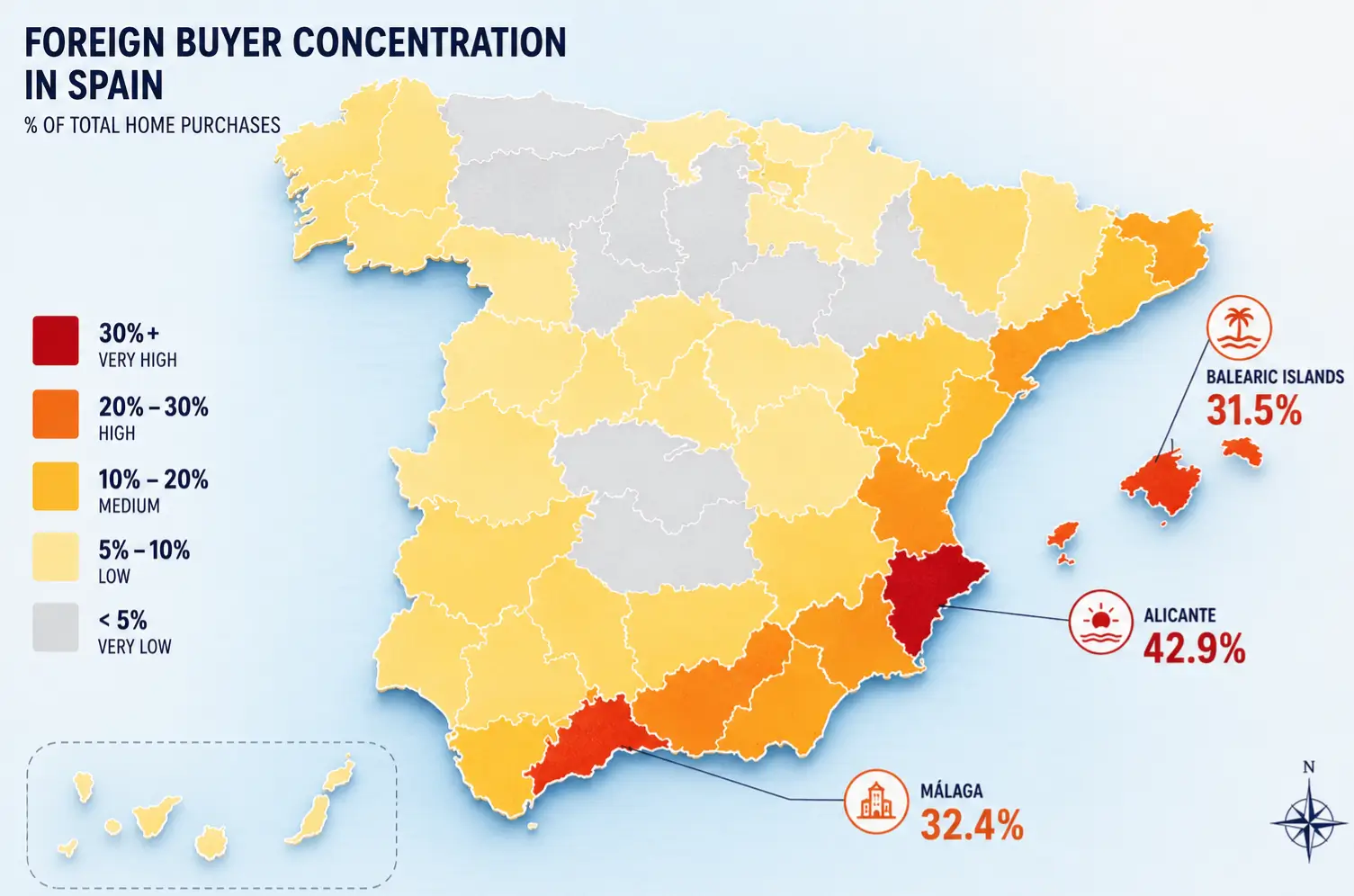
Spain's latest foreign buyer statistics reveal something far more significant than a strong property market. They highlight the growing importance of cross-border capital flows and the infrastructure required to support them.
According to data published by the Colegio de Registradores de España, foreign buyers purchased 71,155 residential properties during the first half of 2025, representing an increase of approximately 2% year over year.
Foreign buyers now account for around one in every five residential property transactions in Spain, confirming that international demand continues to play a fundamental role in the country's real estate market.
The geography of foreign investment
While the national figures are significant, the regional data tells an even more compelling story.
| Province | Share of Foreign Buyers |
|---|---|
| Alicante | 42.9% |
| Málaga | 32.4% |
| Balearic Islands | 31.5% |
| Spain (National Average) | 13–19% |
These numbers demonstrate that certain regions are no longer simply attracting overseas buyers — they have become international investment hubs.
Alicante, for example, derives nearly half of its residential property transactions from foreign purchasers. Similar patterns can be seen along Spain's Mediterranean coastline and island markets, where international demand has become a structural component of the local economy rather than a temporary market cycle.
Who is buying?
The largest groups of foreign buyers during the first half of 2025 were:
- British buyers — 5,731 purchases
- Moroccan buyers — 5,654 purchases
- German buyers — 4,756 purchases
- Ukrainian buyers — 2,165 purchases (a record high)
Each nationality brings different financing methods, regulatory requirements and settlement expectations, but every transaction follows a remarkably similar operational journey.
Every international property purchase requires more than a payment
Behind every cross-border property transaction lies a complex coordination process involving multiple financial and legal stakeholders.
A typical international purchase requires:
- Foreign exchange conversion
- Cross-border payment execution
- Multi-jurisdiction compliance checks
- Bank coordination
- Notary execution
- Land Registry confirmation
Despite this complexity, the majority of international property transactions still rely on traditional payment rails such as SWIFT.
The hidden cost of cross-border property transactions
Assuming an average property value between €300,000 and €400,000, buyers frequently incur around 3% in combined foreign exchange spreads, banking fees and settlement friction.
That represents an additional cost of approximately:
€9,000–€12,000 per property transaction
Across more than 71,000 international purchases, this translates into hundreds of millions of euros lost each year to payment inefficiencies rather than value creation.
A cross-border infrastructure opportunity
Viewed through this lens, these statistics are about much more than real estate.
They illustrate the growing demand for modern infrastructure capable of simplifying international property transactions through better payment coordination, regulatory compliance and settlement efficiency.
As cross-border investment continues to expand across Southern Europe, the quality of transaction infrastructure will increasingly become a competitive advantage for buyers, sellers, legal professionals and financial institutions alike.
A strategic question for Fintech builders
For companies building infrastructure around cross-border property transactions, two distinct strategies emerge.
Option 1: Volume Corridors
Focus on the highest-volume international routes, such as:
- United Kingdom ↔ Spain
- Morocco ↔ Spain
This strategy prioritises transaction volume and operational scale.
Option 2: High-Value Precision Segments
Target buyers from markets such as:
- Germany
- United States
These transactions often involve higher property values, stricter compliance requirements and greater demand for secure, efficient execution.
While volume maximises scale, precision markets can offer stronger margins and greater defensibility through specialised services.
Neither strategy is inherently better.
The right choice depends on the infrastructure being built — and the long-term vision behind it.
The future of international property transactions
As international property investment continues to grow across Southern Europe, one question becomes increasingly relevant:
Will the next generation of innovation focus on moving more money, or on moving it more intelligently?