

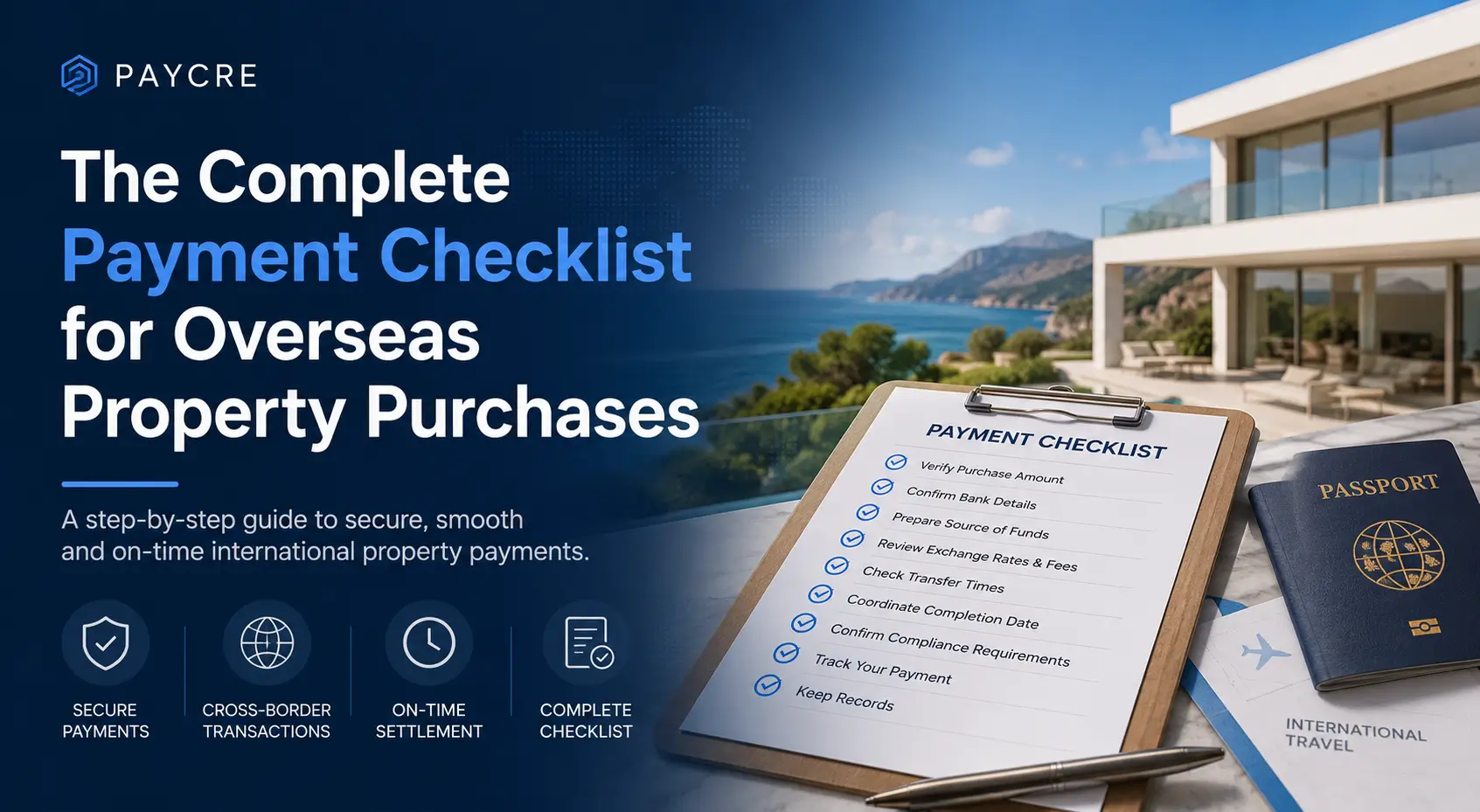
Buying property abroad is an exciting milestone, but transferring the purchase funds is often where unexpected challenges arise. International property transactions involve more than simply sending money from one bank account to another. Compliance checks, exchange rate fluctuations, settlement timing, and coordination between multiple parties can all affect whether your purchase completes on schedule.
This checklist will help you prepare for the financial side of an overseas property purchase and reduce the risk of costly delays.
1. Confirm the total amount required
Before initiating any payment, obtain a complete breakdown of the funds required. This should include:
- Property purchase price
- Reservation deposit
- Balance due at completion
- Taxes and government fees
- Legal fees
- Notary or land registry costs
- Agency commissions (where applicable)
- Bank or payment provider fees
Knowing the exact amount helps avoid last-minute funding shortfalls that could delay completion.
2. Verify the recipient's bank details
Always verify payment instructions directly with your lawyer, notary, or the authorised representative handling the transaction. Never rely solely on payment instructions received by email, as business email compromise and payment fraud remain significant risks in international real estate transactions.
Confirm:
- Beneficiary name
- IBAN or account number
- SWIFT/BIC code
- Receiving bank details
- Payment reference
3. Prepare Your Source of Funds documentation
Financial institutions are required to verify the origin of funds used in high-value transactions.
Prepare documents such as:
- Recent bank statements
- Salary or employment records
- Sale agreements from previous property sales
- Investment statements
- Inheritance documentation
- Company financial records (if purchasing through a business)
Providing this documentation early can significantly reduce compliance delays.
4. Understand currency exchange costs
If your funds must be converted into another currency, compare more than just the advertised exchange rate.
Evaluate:
- Exchange rate margins
- Transfer fees
- Receiving bank charges
- Potential intermediary bank deductions
Even small differences in exchange rates can represent thousands of euros on large property purchases.
5. Check payment processing times
International transfers are not always immediate.
Processing times depend on:
- Country of origin
- Receiving country
- Bank cut-off times
- Compliance reviews
- Public holidays
Never assume funds sent today will arrive today.
6. Coordinate completion dates carefully
Your payment timeline should align with the legal completion schedule.
Coordinate with:
- Your lawyer
- The seller's representative
- Your payment provider
- Your bank
- The notary (where applicable)
Sending funds too early may expose you to unnecessary risk, while sending them too late could postpone completion.
7. Confirm compliance requirements in advance
Some transactions trigger additional verification checks due to:
- Transaction value
- Country involved
- Funding source
- Corporate ownership structures
- Use of digital assets or cryptocurrency
Understanding these requirements before completion helps prevent unexpected requests that could delay settlement.
8. Keep a financial buffer
Avoid transferring every available euro into the purchase.
Maintain additional funds for:
- Unexpected taxes
- Exchange rate movements
- Additional legal costs
- Property registration fees
- Utility connections
- Immediate repairs or maintenance
9. Track Your payment
After initiating the transfer, obtain confirmation that the payment has:
- Left your account
- Passed intermediary banks (if applicable)
- Reached the receiving institution
- Been credited to the beneficiary
Real-time visibility reduces uncertainty and allows issues to be identified before they affect completion.
10. Keep records of everything
Maintain copies of:
- Payment confirmations
- Transfer receipts
- Currency exchange confirmations
- Invoices
- Contracts
- Email correspondence
- Compliance documentation
These records may be required for legal, tax, or future property transactions.
Common mistakes to avoid
- Waiting until the last minute to transfer funds.
- Ignoring exchange rate fluctuations.
- Sending money without independently verifying bank details.
- Assuming all international transfers arrive within one business day.
- Underestimating compliance and source-of-funds checks.
- Failing to coordinate payment timing with legal completion.
Overseas property purchases involve much more than finding the right home or investment. A successful transaction depends on careful coordination between buyers, sellers, lawyers, financial institutions, and payment providers.
Preparing your payment well in advance helps minimise delays, reduces financial risk, and ensures that your transaction progresses as smoothly as possible. Whether you're buying a holiday home in Spain, an investment apartment in Portugal, or a villa in Greece, a structured payment plan is just as important as the purchase agreement itself.
Need support coordinating an international property payment?
Paycre helps buyers, sellers, legal professionals, and real estate partners coordinate secure cross-border property transactions with structured payment solutions in both fiat and digital assets, providing greater visibility and confidence throughout the settlement process.