
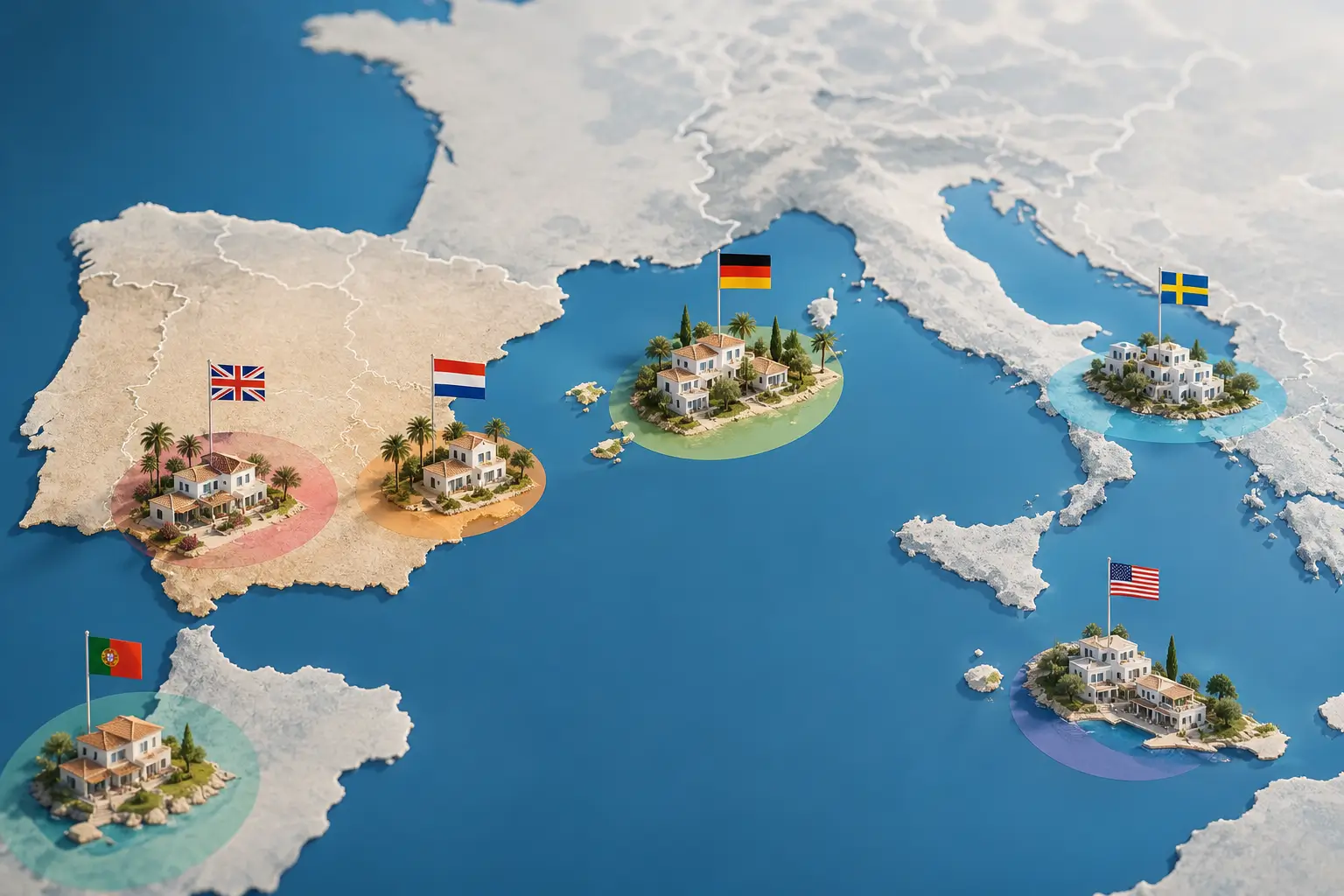
Germans own Mallorca. The British own the Costa del Sol. The Dutch are taking over the Costa Blanca.
But when you map the data, something stranger appears:
Foreign buyers don't spread evenly across a country.
They form enclaves.
And sometimes the enclave isn't a region.
It's a town.
🇩🇪 MALLORCA: THE GERMAN ENCLAVE
In the Balearics, Germans account for 43.5% of foreign property demand.
In Palma, it's 44%.
And some smaller Mallorcan markets are even more concentrated:
• Canyamel: 67.2% German
• Cala d'Or: 67.1%
• Cala Ratjada: 63.1%
This isn't simply Germans discovering Mallorca.
It's a market that has developed its own German ecosystem:
Language, services, communities, agents, professionals and decades of existing ownership.
Once the ecosystem exists, the next buyer has less friction.
And that creates a feedback loop.
Buyers follow buyers.
🇳🇱 COSTA BLANCA: THE DUTCH CORRIDOR
A similar pattern is emerging in Alicante.
Dutch buyers are one of the strongest foreign groups in the province, with demand particularly visible across the Costa Blanca.
Jávea.
Torrevieja.
Calpe.
Moraira.
But here's where the story gets much more interesting.
Look at San Miguel de Salinas.
Between June 2025 and May 2026, 528 homes were sold there.
Only 49 went to Spanish buyers.
More than 90% went to foreigners.
Nearby:
• Rojales - 88.3% foreign buyers
• Algorfa - 87.2%
• Benijófar - 82.6%
• San Fulgencio - 82.1%
These aren't international capitals.
They're relatively small Spanish municipalities.
Yet foreign buyers dominate the housing market.
Why?
Because once an area has an established foreign community, it creates its own infrastructure.
The next buyer doesn't have to start from zero.
They can find people who speak their language.
They can ask another foreign owner which lawyer they used.
Which agent understands their market.
Which doctor speaks their language.
Which bank handles their situation.
Which neighbourhood has people like them.
The community itself becomes part of the property product.
🇬🇧 THE BRITISH: SOUTHERN SPAIN
The British enclave is older.
British buyers remain particularly prominent across Málaga, Almería, Murcia and other parts of southern Spain.
This isn't just about climate.
Decades of migration and second-home ownership have created an ecosystem of British-oriented businesses, services, communities and professional networks.
Which means the decision isn't simply:
"Why Spain?"
It becomes:
"Where in Spain do people like me already live?"
That's how an enclave becomes self-reinforcing.
🇸🇪 THE SWEDISH: A SECOND MALLORCAN LAYER
The Swedish pattern is smaller, but the same mechanism appears.
In Palma, Swedes represent 11.7% of foreign demand.
On the Costa Blanca, Swedish buyers are also highly visible.
The interesting question isn't only why Swedes choose Spain.
It's why particular Spanish locations repeatedly appear in Swedish buyer searches.
That is the difference between international demand and an international corridor.
🇺🇸 THE AMERICANS: A DIFFERENT KIND OF ENCLAVE
American demand looks different again.
In Málaga, Americans are now the largest foreign source market for property demand.
They also lead foreign demand in Cádiz.
And American interest is particularly visible in higher-value markets such as Málaga, Marbella, Madrid and parts of the Balearics.
So not every enclave is created by volume.
Some are created by value.
🇵🇹 AND IT DOESN'T STOP AT SPAIN
Portugal shows the same phenomenon.
In May 2026, US buyers represented 44% of international property-search demand in Ponta Delgada, Azores.
Canada represented another 21%.
In Funchal, British buyers led with 19%.
In Faro, British buyers led with 16%.
In Santarém, British buyers represented 24%.
In Vila Real, Swiss buyers represented 29%.
Same country.
Completely different foreign-buyer maps.
🇬🇷 GREECE SHOWS ANOTHER VERSION
Crete has become the leading destination for foreign holiday-home buyers in 2026, with buyers coming mainly from the Netherlands, Germany, Belgium, France and the UK.
Again, the interesting question isn't simply:
"Why Greece?"
It's:
Why Crete?
Why this island?
Why this town?
Why this development?
Why do buyers from the same country repeatedly follow the same geographical paths?
SO WHY DO ENCLAVES FORM?
Usually, it's not one reason.
It's a combination of:
1. Climate and lifestyle — The original reason many buyers arrive.
2. Price — A location may offer a type of property that is expensive or unavailable at home.
3. Accessibility — Direct flights and travel time matter enormously.
4. Existing communities — People trust places where people from their own country already live.
5. Language and services — Agents, lawyers, doctors, accountants and other professionals adapt to the dominant foreign market.
6. Information — Existing owners become an informal information network.
7. Network effects — Every new buyer makes the location slightly easier for the next buyer.
And this creates a fascinating cycle:
Foreign buyers arrive →
communities form →
local infrastructure adapts →
friction falls →
more buyers arrive.
That's how a foreign-buyer enclave can emerge.
And eventually something else happens.
The geographical enclave becomes a financial corridor.
🇳🇱 Netherlands → Costa Blanca
🇩🇪 Germany → Mallorca
🇬🇧 UK → Southern Spain
🇺🇸 US → Málaga / high-value markets
🇬🇧 UK → Algarve / parts of Portugal
🇺🇸 US → Azores
Now add the transaction layer.
Different currency.
Different bank.
Different compliance requirements.
Different tax questions.
Different documentation.
Different professional networks.
Different time zones.
The geography of foreign property demand becomes the geography of cross-border transactions.
Foreign capital doesn't simply flow into a country.
It flows through corridors.
And some of those corridors are surprisingly small.
Sometimes the most revealing place on the map isn't Madrid.
It's a town like San Miguel de Salinas, where more than 90% of recent home purchases went to foreign buyers.
The question isn't just:
"Where are foreigners buying?"
It's:
"Why did this particular place become their place?"
What's the strangest enclave you've seen in your market?