

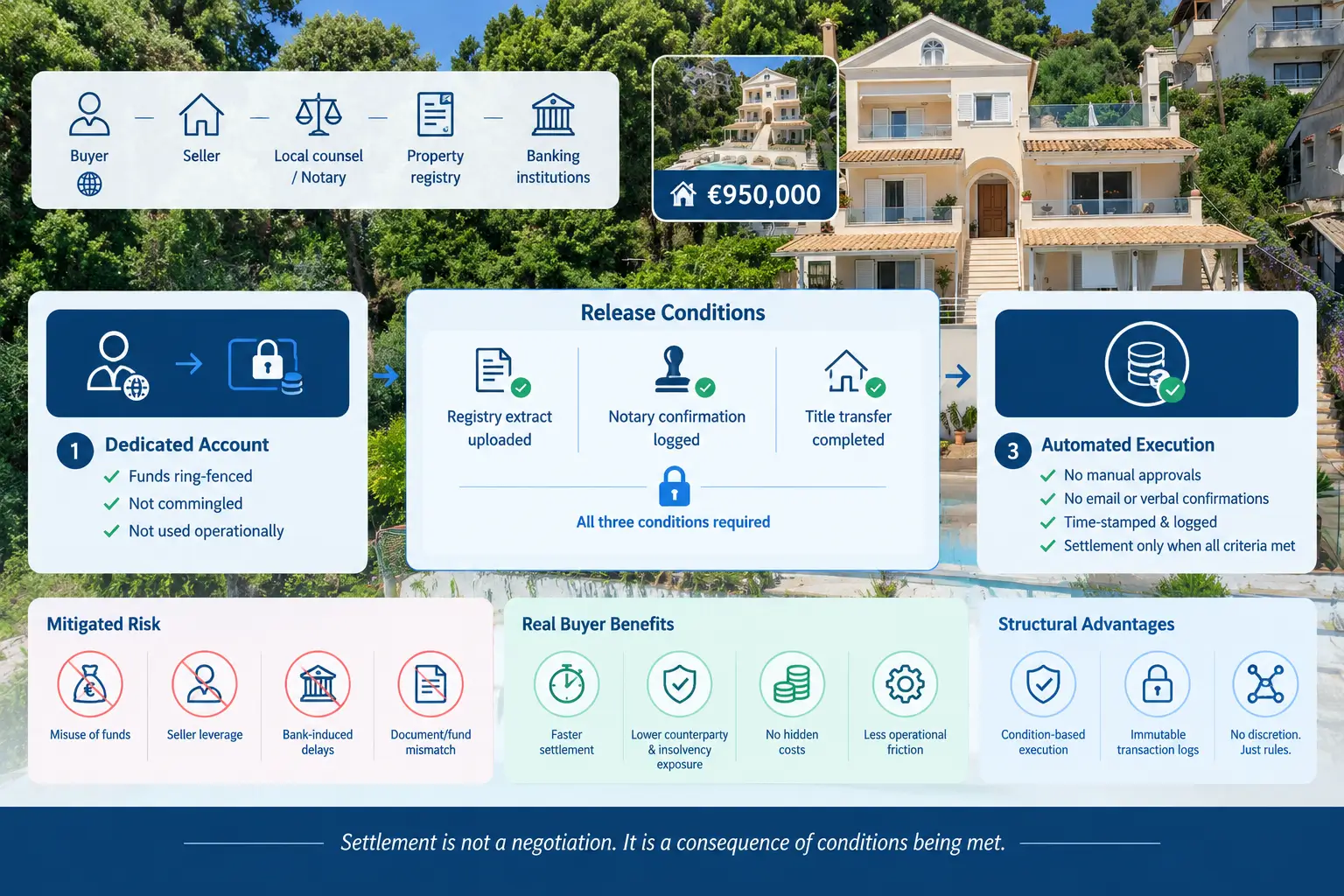
A non-resident buyer recently completed the acquisition of a €950.000 residential property in Greece. The transaction involved the usual parties: buyer, seller, local counsel/notary, property registry, and banking institutions.
In conventional cross-border executions, funds are wired to pooled client accounts, visibility is limited, release depends on manual confirmations, and documents and funds move asynchronously. The structural issue is that funds are controlled by people rather than conditions.
For this transaction, settlement was structured by Paycre around deterministic conditions:
1. The buyer funded a dedicated account. Funds were ring-fenced, not commingled with other client balances, and not used operationally by intermediaries.
2. Release was locked to three objective criteria: registry extract uploaded, notary confirmation logged, and title transfer completed. Until all three were satisfied, funds could not move, not by the seller, not by counsel, and not by the service provider.
3. The process did not rely on email confirmations, verbal assurances, or manual approval. Each step was time-stamped and logged, conditions were verified within the system, and settlement occurred only when all criteria were met.
This structure mitigates several common failure modes: misuse of funds, seller leverage, bank-induced delays, and document/fund mismatch.
The buyer’s benefit was not only a discount. It was also the removal of hidden costs and risks typically accepted in cross-border deals: time compression at settlement, reduced counterparty and insolvency exposure, and lower operational friction from manual reconciliation and follow-up.
This model replaces discretion with structural constraints, condition-based execution, and immutable transaction logs. Trust is not assumed; it is engineered.
Settlement is not a negotiation. It is a consequence of conditions being met.