

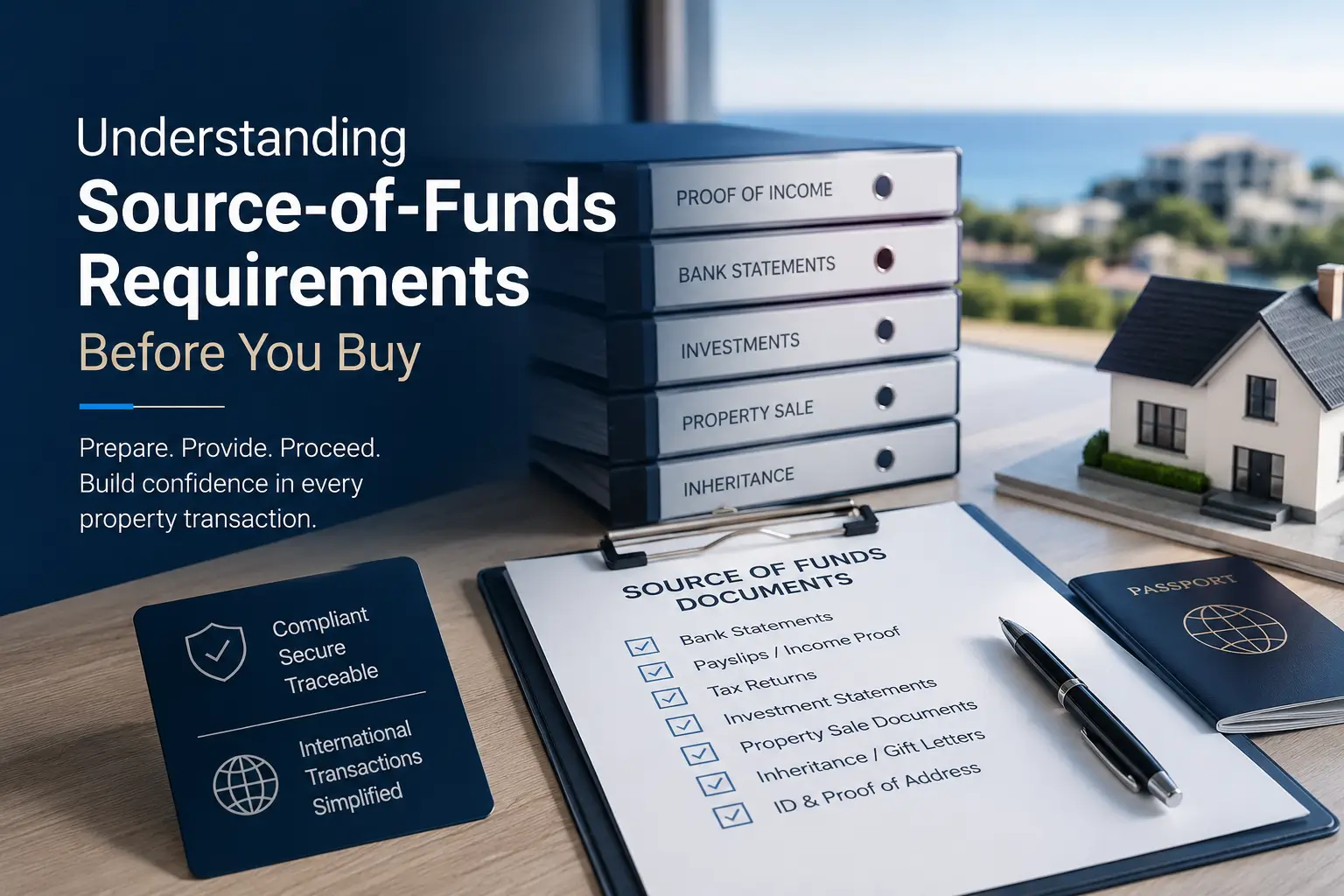
For many international property buyers, one of the biggest surprises isn't finding the right property or negotiating the purchase price—it's proving where the money comes from.
Whether you're buying a holiday home in Spain, an investment apartment in Portugal, or a villa in Greece, you'll almost certainly be asked to provide source-of-funds (SOF) documentation. These checks are a standard part of anti-money laundering (AML) regulations and are designed to ensure that funds used in high-value transactions come from legitimate, traceable sources.
Preparing this documentation before you begin your property purchase can help avoid unnecessary delays and make the closing process considerably smoother.
What is Source of Funds?
Source of funds refers to the specific origin of the money being used for a transaction.
It differs from source of wealth, which explains how an individual accumulated their overall wealth over time.
- Source of wealth: Employment income, business ownership, investments, inheritance, or other long-term assets.
- Source of funds: The actual money being used for the purchase, such as proceeds from selling a property, savings, investment withdrawals, or inherited funds.
Professionals involved in your transaction need to understand both where your wealth originated and where the specific purchase funds came from.
Why are Source-of-Funds checks required?
Property purchases are among the largest financial transactions most people ever make. As a result, lawyers, notaries, banks, payment providers, and regulated businesses are legally required to perform anti-money laundering (AML) and counter-terrorist financing (CTF) checks.
These checks help ensure that the funds used in a transaction are legitimate and protect everyone involved, including:
- Buyers
- Sellers
- Lawyers and legal representatives
- Banks and payment providers
- The wider real estate market
Although the process may seem intrusive, it has become a routine part of international property transactions.
Common documents You may need
The documentation required depends on how you obtained the money being used for the purchase.
Employment Income
- Recent payslips
- Employment contract
- Tax returns
- Bank statements showing salary deposits
Sale of Property
- Sale agreement
- Completion statement
- Bank statement showing receipt of sale proceeds
Savings
- Bank statements covering several months
- Evidence showing how the savings accumulated
Investment Income
- Investment portfolio statements
- Sale confirmations
- Dividend statements
Business Income
- Company financial statements
- Dividend records
- Business sale agreements
- Relevant tax documentation
Inheritance
- Probate documentation
- Copy of the will
- Executor's letter
- Bank statement showing receipt of inherited funds
Gifted Funds
- Gift letter
- Identification of the donor
- Evidence of the donor's source of funds
- Transfer records
Why buyers experience delays
Many buyers assume that simply having enough money is sufficient. In reality, the biggest challenge is often documenting the complete journey of those funds.
Common causes of delays include:
- Incomplete documentation
- Bank statements covering too short a period
- Large unexplained deposits
- Funds transferred through multiple accounts without supporting evidence
- Documents requiring certified translations
- Additional compliance questions raised late in the transaction
If these issues arise shortly before completion, they can delay the entire property purchase.
Source of Funds when using crypto assets
An increasing number of international property buyers hold part of their wealth in cryptocurrencies or other digital assets.
While crypto ownership is increasingly accepted, buyers should expect to provide additional documentation demonstrating:
- How the crypto assets were acquired
- Transaction history from exchanges or wallets
- Evidence of conversion into fiat currency
- Bank statements showing receipt of converted funds
- Relevant tax reporting where applicable
Maintaining organised records throughout your investment journey can make compliance much simpler when you're ready to purchase property.
Prepare before You make an offer
One of the most effective ways to avoid delays is preparing your documentation before entering serious negotiations.
Your compliance file may include:
- Passport or government-issued identification
- Recent proof of address
- Bank statements
- Evidence of employment or income
- Documentation supporting the source of purchase funds
- Tax documentation where required
- Property sale or investment records
Having everything ready allows your legal and financial advisers to respond quickly when compliance checks begin.
The value of professional coordination
International property purchases often involve multiple parties, including lawyers, estate agents, banks, payment providers, compliance teams, and notaries.
Without proper coordination, buyers frequently find themselves submitting the same documents multiple times, answering duplicate questions, and dealing with unnecessary delays.
A coordinated transaction process helps ensure documentation is collected early, reviewed for completeness, and securely shared with the appropriate professionals, making the entire transaction more efficient.
Source-of-funds checks are not designed to create obstacles—they are an essential safeguard in today's international property market.
Understanding the documentation you'll need, preparing it early, and working with experienced professionals can significantly reduce delays and give you greater confidence throughout the buying process.
Whether your funds come from employment, investments, property sales, business income, inheritance, or digital assets, good preparation is one of the smartest investments you can make before purchasing property abroad.