

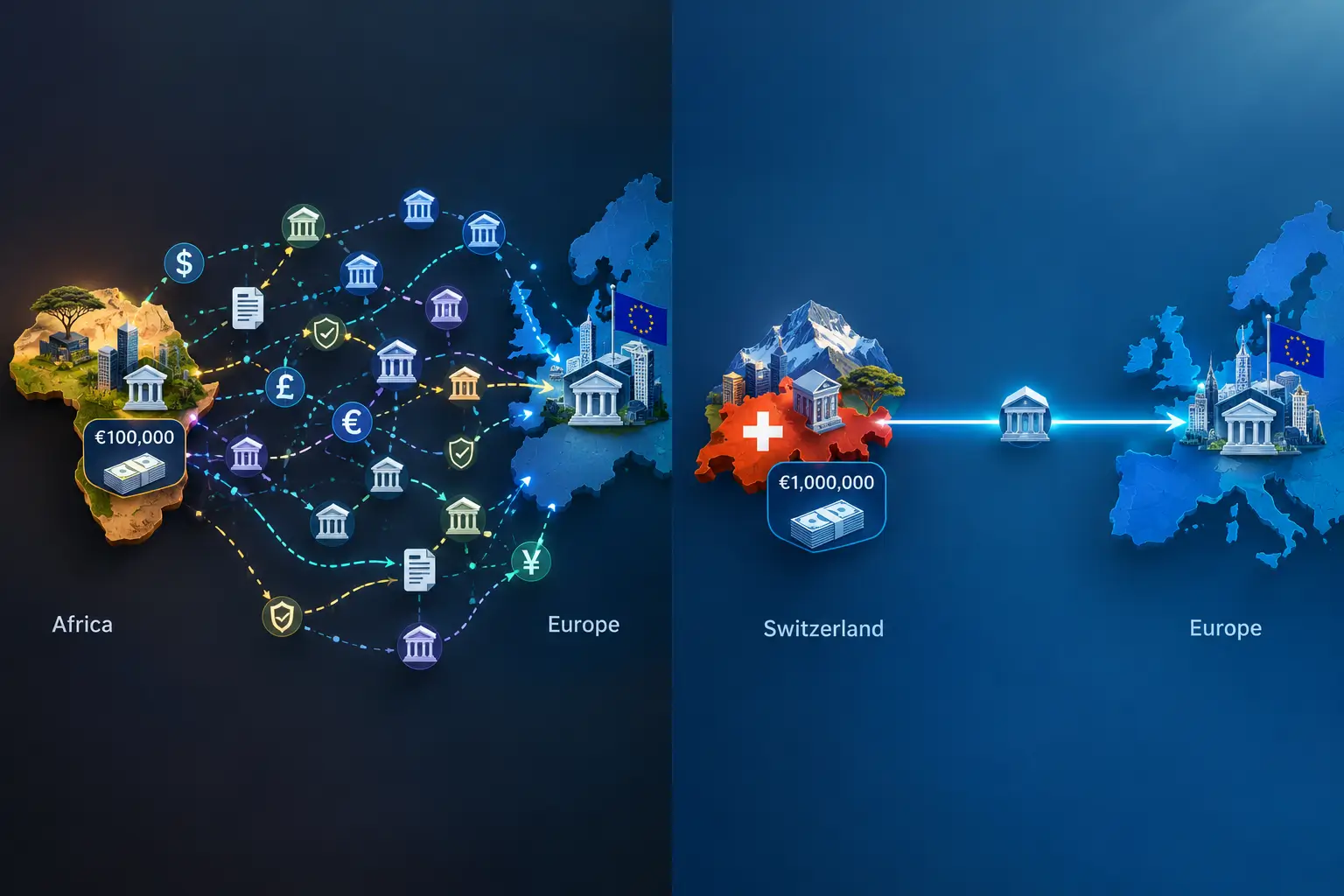
Why can €100.000 from Africa be harder to move than €1 million from Switzerland?
Because the difficulty of a cross-border transaction is not always proportional to the amount.
A €1 million payment from Switzerland may travel through mature banking and financial infrastructure.
A €100.000 payment originating from an emerging-market corridor can encounter a completely different set of questions.
Which bank can send it?
Which currency?
Which correspondent route?
What documentation is required?
How is the source of funds demonstrated?
Will the receiving bank accept the payment?
What happens if an intermediary asks for additional information?
And who is coordinating the receiving side of the transaction?
The money can be completely legitimate. The buyer can be completely legitimate. The transaction can be completely legitimate. The corridor can still be difficult.
The problem is often the corridor, not the amount
This is one of the problems we increasingly see in international transactions.
And it changes the way we think about “high-value”.
High-value does not necessarily mean €1M+.
Sometimes €100.000 is a high-complexity transaction.
A customer in Africa may want to buy property in Europe.
Or invest.
Or relocate.
Or acquire a business.
The payment provider may be perfectly capable of moving the money.
But the customer isn't only asking:
“Can you send my €100.000?”
They are effectively asking:
“Can you help me get this transaction completed?”
That is a different problem.
Moving the money is only one part
The financial provider handles the financial rails.
The lawyer handles the legal work.
The notary handles the required notarial process.
The property professional handles the property.
But someone still has to make the pieces work together across the corridor.
That becomes particularly important when the transaction crosses jurisdictions, currencies and different financial systems.
The opportunity for Paycre
This is where Paycre sees an opportunity.
Not to replace banks.
Not to replace payment providers.
Not to become another FX company.
But to provide an execution layer for cross-border transactions where the complexity of the corridor matters as much as the size of the transaction.
A financial institution may be able to move the money.
Paycre can help manage the transaction around it.
That can mean connecting the buyer, seller, property documentation, legal professionals, notary, payment process and completion milestones into one transaction workflow.
The real measure of a high-value transaction
The traditional way to look at international transactions is to focus on the amount.
€50.000.
€100.000.
€1 million.
€10 million.
But transaction difficulty does not always follow the same curve.
A smaller payment from a complex corridor can require considerably more work than a much larger payment from a highly developed financial system.
The question isn't only: “How much money are you moving?”
The better question is: “How difficult is it to get the transaction from origin to completion?”
Sometimes €100.000 can be much harder than €1 million.
Meta description: Why can €100,000 from Africa be harder to move than €1 million from Switzerland? Explore how cross-border corridors, banking infrastructure and transaction complexity can matter more than transaction size.
Hashtags: CrossBorderPayments, Africa, Fintech, InternationalTransactions, FX, Payments, FinancialInfrastructure, CrossBorderTransactions, EmergingMarkets, TransactionExecution, Paycre