

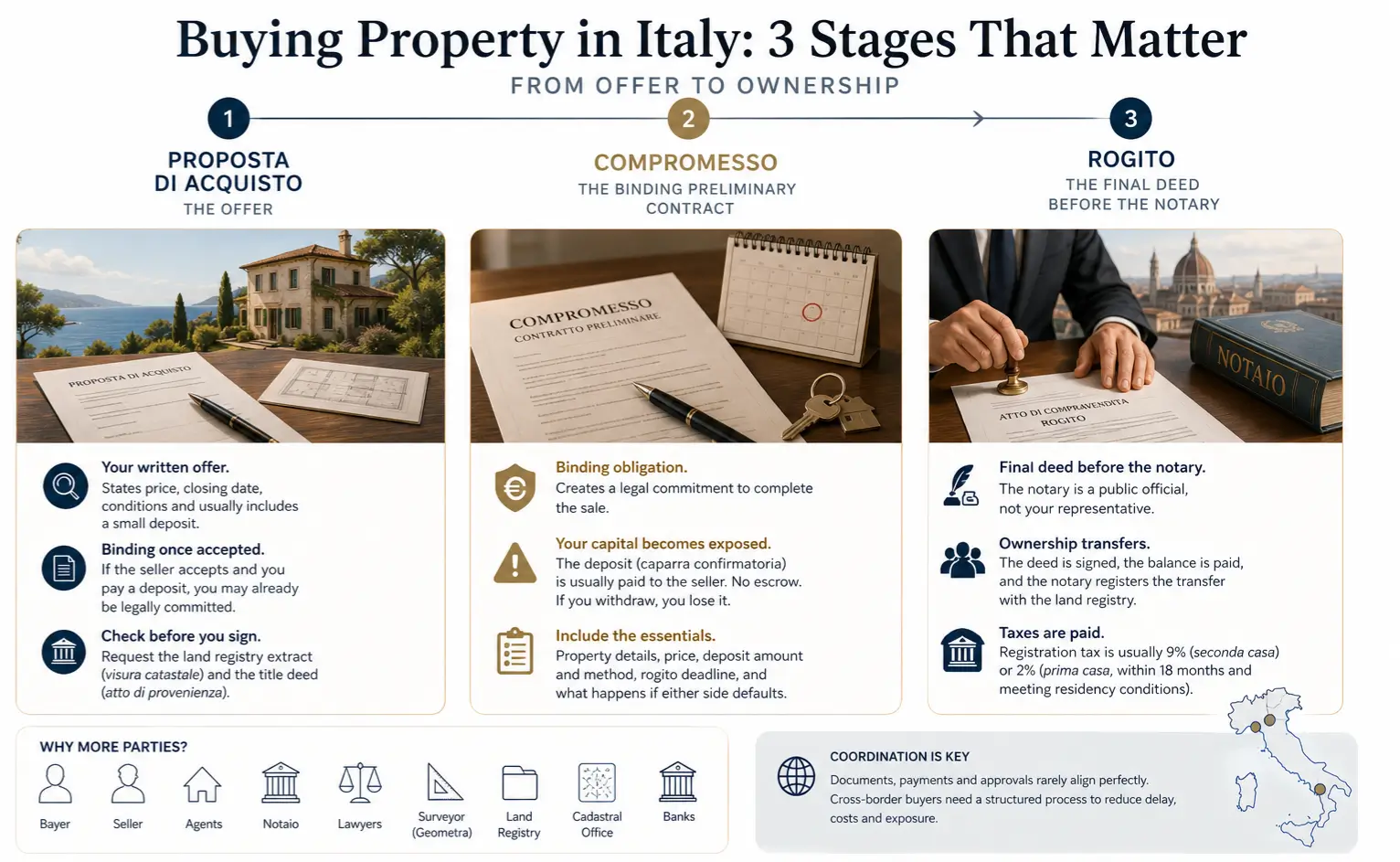
Bottom line: Buying property in Italy as a foreigner follows three stages: the proposta (offer), the compromesso (binding preliminary contract), and the rogito (final deed before a notary). The compromesso is where your money becomes exposed. The rogito is where ownership actually transfers. Most foreign buyers are surprised by how much happens between the two.
Why the Italian process feels different from what You expected
If you have bought property in the UK, the US, or much of Northern Europe, the Italian sequence will not match your instincts.
There is no single exchange of contracts. There is no escrow account holding your deposit until completion. There is no title insurance industry standing behind the transaction.
Instead, there is a notary who acts for the state, a seller who may be one person or six heirs, and a deposit that leaves your account before anyone has verified that the seller can legally sell.
Understanding the three stages, and what each one actually commits you to, is the difference between a controlled purchase and an expensive lesson.
Stage One: The Proposta di Acquisto
The proposta di acquisto is your written offer. It states the price, the proposed closing date, any conditions, and usually comes with a small deposit attached.
This is where foreign buyers make their first mistake: assuming the proposta is informal.
A proposta that the seller accepts becomes a binding contract in its own right. If you attach a deposit and the seller signs, you may have already committed to buy before you have seen the property documents, confirmed title, or understood what you are purchasing.
What to check before you sign a proposta
Ask for the visura catastale (land registry extract) and the atto di provenienza (the seller’s title deed) before you put anything in writing. Confirm the seller’s identity matches the registry. If the property is inherited, confirm how many heirs are on title and whether any of them are minors, since a minor’s share requires court authorization to sell.
A proposta that does not reference these documents is an offer made blind.
Stage Two: The Compromesso
The compromesso is the preliminary contract. Under Italian law it is a contratto preliminare, and it creates a binding obligation to complete the sale.
This is where the deposit, the caparra confirmatoria, is normally paid. Typical amounts run 10% to 30% of the purchase price, negotiated between the parties.
The mechanics matter more than the terminology. We covered them in full in The Italian Compromesso: Why the Deposit Is Binding, but the short version is this: if you withdraw, you lose the deposit. If the seller withdraws, he owes you double.
The compromesso is where your capital becomes exposed
The deposit usually transfers directly to the seller on signing day. There is no escrow. Once the money leaves your account, you have no practical control over it, and recovering it if the deal collapses can take years.
Compare that with the final balance at the rogito, where funds are released only when title transfer completes and every condition is logged. The caparra has none of that protection. It is the first money out and the most exposed.
What the compromesso should contain
At minimum: the full property description matching the registry, the agreed price, the deposit amount and payment method, the rogito deadline, and what happens if either side fails to appear.
If the property has known defects, planning irregularities, or an outstanding mortgage, these belong in the compromesso as conditions. Once you sign without them, you have accepted the property as-is.
Stage Three: The Rogito
The rogito is the final deed. It is signed before an Italian notary, who is a public official, not your representative. The notary’s job is to ensure the transaction is lawful and the transfer is properly registered. He does not act for you.
This is a point foreign buyers frequently misunderstand. Your lawyer protects your interests. The notary protects the validity of the act. They are not the same role.
What happens at the rogito
Both parties appear, or attend by proxy with a procura speciale. The notary reads the deed aloud. The balance of the purchase price transfers, usually through the notary or a bank-coordinated movement. The notary then registers the transfer with the land registry and the cadastral office.
Ownership passes when the deed is signed, not when the registry is updated. But the registry update is what makes the transfer enforceable against third parties.
Taxes paid at or around the rogito
For a non-resident buying a seconda casa (not a primary residence), the registration tax is typically 9% of the cadastral value, plus fixed mortgage and cadastral taxes. If you declare the property as your prima casa within 18 months of purchase and meet the residency conditions, the registration tax drops to 2%. [VERIFY current rates and residency conditions with your Italian lawyer before relying on them.]
These figures are calculated on cadastral value, not purchase price, which is why a €1M property and a €700K property can carry similar tax bills. It also means the buyer’s cash requirement is not simply the price plus a percentage.
Why Italian Transactions Involve More Parties
A typical Italian purchase can involve: the buyer, the seller, one or more agents, a notaio, a lawyer for each side, a geometra or surveyor, the land registry, the cadastral office, and one or more banks.
Each party has a defined role and none of them owns the whole sequence. That fragmentation is structural, not a sign that something is wrong.
It is also why payments and documents can arrive out of order. Your funds may be ready while the seller’s title documents are not. The notary may be available while the cadastral correction is still pending. The compromesso deadline may be approaching while the succession paperwork on the seller’s side is still open.
For a cross-border buyer, this is where coordination matters more than speed. A transfer that arrives early does not help if the transaction is not ready to receive it, and in Italy it creates its own exposure, as we set out in how to move €500K+ without losing 3–7%.
What This Means for You
Five things to lock down before you start.
1. Appoint your own lawyer before the proposta, not after. Your lawyer reviews the title, the registry extract, and any planning issues. The notary does not do this for you.
2. Do not sign a proposta you would not be willing to enforce. An accepted proposta can bind you. Treat it as the first contract, not a warm-up.
3. Know exactly where the caparra goes. Direct to the seller is standard. If a lawyer or agent holds it, get the release conditions in writing. If you cannot establish who controls the funds and when they move, do not sign.
4. Build the full cash requirement, not just the price. Registration tax, notary fees, agent commission, lawyer fees, and any cadastral corrections. On a €1M purchase, these can add a meaningful percentage on top of the price.
5. Align your funding timeline with the rogito deadline. If your currency transfer or mortgage approval runs 60 days and the compromesso gives you 45, you are exposed before you start.
If you are mapping the funding sequence for an Italian purchase now, Paycre can help you lay out the deposit-to-rogito path and identify where your capital sits unprotected. We work across Spain, Portugal, Italy, and Greece, and the failure modes differ by country in ways that matter.