

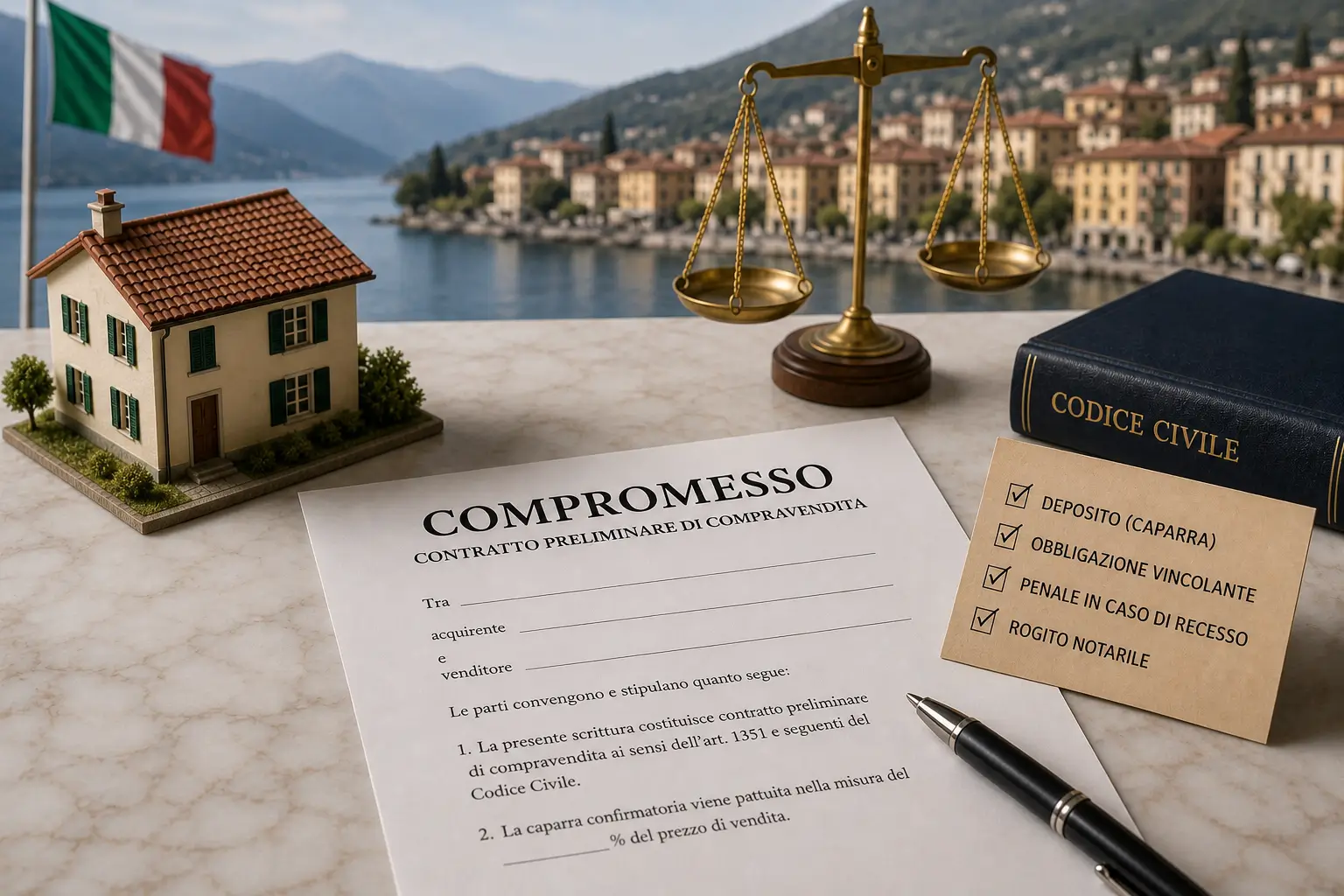
Bottom line: The Italian compromesso is not a letter of intent. It is a binding contract. Once you sign it, you are legally obligated to complete the purchase. Walking away typically costs you the entire deposit, usually 10% to 30% of the price.
Why the Compromesso binds You more than You expect
Most cross-border buyers treat the deposit stage as a soft commitment. A moment to lock in the price, keep negotiating, and walk away if something better comes along.
Italy does not work that way.
The compromesso is a contratto preliminare under Italian law. It creates a legal obligation to sign the final deed, not a moral one. From the moment both parties sign, either side can go to court to force the sale. The fact that you have not yet been to the notary changes nothing.
This gap between what buyers assume and what Italian law actually does is where most deposit disputes begin. Buyers arrive from markets where a reservation deposit is refundable, or where a preliminary agreement is treated as a negotiating document. Neither assumption survives contact with an Italian notary.
How the Caparra Confirmatoria actually works
The deposit in an Italian property purchase is a caparra confirmatoria, governed by Article 1385 of the Italian Civil Code.
The mechanics are simple. The consequences are not.
If you walk away: the seller keeps the deposit. No negotiation required. If the seller can prove actual damages exceed the deposit, he can pursue the difference.
If the seller walks away: he owes you double the deposit. This is why sellers rarely back out after signing.
If the deal closes: the deposit counts toward the purchase price and is deducted from your balance at the rogito.
One detail that catches buyers off guard: the 10% to 30% range is not set by law. It is negotiated. In competitive markets or for higher-value properties, sellers push for 20% or 30%. On a €1,5M property, that is €300.000 to €450.000 leaving your account on signing day.
That money is no longer under your control the moment it lands in the seller’s account.
What the caparra is not
The caparra is not a penalty clause you can negotiate your way out of after the fact. It is not a fee. It is not a deposit in the Anglo-American sense, where the buyer typically retains some equitable interest in the funds until closing conditions are satisfied. Under Italian law, once the money moves, it is the seller’s to keep if you fail to perform.
If You withdraw: What You actually lose
Say you sign the compromesso, pay 10%, then decide not to proceed. Your financing fell through. Your currency transfer was delayed. You changed your mind.
First consequence: the deposit is forfeited. This is automatic. The seller does not need a court order to keep it.
Second consequence: if the seller can document losses beyond the deposit, he can claim the excess. A property that sat off-market for four months, a relocation the seller already committed to, a chain purchase that collapsed. These are recoverable.
Third consequence, rarely triggered but real: if the compromesso includes an enforcement clause, a court can order specific performance. You complete the purchase whether you want to or not. In practice, sellers usually take the deposit and move on. But the legal exposure exists.
If the Seller withdraws: Why You get double back
Seller-side breach is cleaner. If he takes your caparra and then refuses to appear at the rogito, you have two options.
Accept double the deposit. You get 2x back and the transaction ends.
Sue for specific performance. You can force the sale through the courts. Most cross-border buyers do not take this route. The timeline runs into years, and you must prove you were ready, willing, and able to close.
A practical read: when a seller backs out, it usually means someone else offered more. The double-deposit penalty may be cheaper than the premium he is capturing elsewhere.
From Compromesso to Rogito: Where the money actually sits
The window between signing the compromesso and signing the rogito typically runs two to four months. It depends on financing, title checks, and whether there are co-owners or inheritance issues to clear.
The deposit usually transfers directly to the seller on signing day. Once it leaves your account, you have no practical control over it. If the deal later collapses because of the seller, recovering double the deposit may require litigation measured in years.
This is the structural weakness. On a €1M purchase with a 20% caparra, you are moving €200.000 into an account you do not control, weeks before the notary confirms anything. Compare that to the final balance, where funds are released only when title transfer completes and each condition is logged. That is the protection a caparra does not have. It is the first money out and the most exposed.
This is also where sequencing decisions get expensive. As we set out in how to move €500K+ without losing 3–7%, sending money too early creates a different risk: capital sitting somewhere while the transaction is not ready to complete. In an Italian purchase, that window is the caparra-to-rogito gap, and it is where your leverage is weakest.
What happens if the Seller passes away before the Rogito
This is a real scenario, and it is rarely planned for.
The compromesso survives the seller’s death. The obligation passes to the heirs. When they accept the estate, they accept the duty to complete the sale.
But there is a legal limit that matters. If the compromesso concerns nuda proprietà, and the seller held only usufrutto, the situation changes significantly. Under Italian Supreme Court precedent, when the usufrutto extinguishes at death and the heirs consolidate full ownership, the buyer cannot simply enforce the original compromesso. The heirs’ obligation is no longer the same obligation.
For a standard full-title purchase, the heirs must complete the succession process before they can appear at the rogito. That can add two to six months. During that time, your deposit sits inside the estate. You coordinate with heirs, possibly several of them, before the deal can move forward.
If the estate has multiple heirs and one of them disputes the sale, you are not negotiating with a seller anymore. You are waiting on a succession procedure you have no standing to accelerate.
What this means for You
Before you sign the compromesso, confirm five things.
1. The money is already liquid. Not “arriving next week.” Not “pending a transfer.” The caparra leaves your account on signing day. If funds are still in transit, wait.
2. You are buying full title, not nuda proprietà. If usufrutto is involved, the enforcement risk after the seller’s death is materially higher. Get this confirmed in writing before signing.
3. The compromesso states a rogito deadline and what happens if it slips. There is no statutory maximum. The date is whatever both parties agree to. If your financing or currency transfer has a timeline, put it in the contract.
4. You understand what the deposit percentage costs you. The difference between 10% and 30% is not a rounding error. On a €2M property, that is €200.000 versus €600.000 in exposure.
5. You know where the deposit goes and under what conditions it returns. Caparra typically goes straight to the seller. If a lawyer or agent holds it in escrow, confirm the release conditions in writing.
If you are reviewing compromesso terms now, Paycre’s cross-border payment team can map the full funding path from deposit to rogito and flag where your capital is exposed. We have seen enough transactions stall at the deposit stage to know which structures hold and which do not.